
Reproduction
- Giraffes do not have a mating season determined by the seasons. Our late giraffe bull, Yoda, made several successful mating attempts with our female giraffe in 2018!
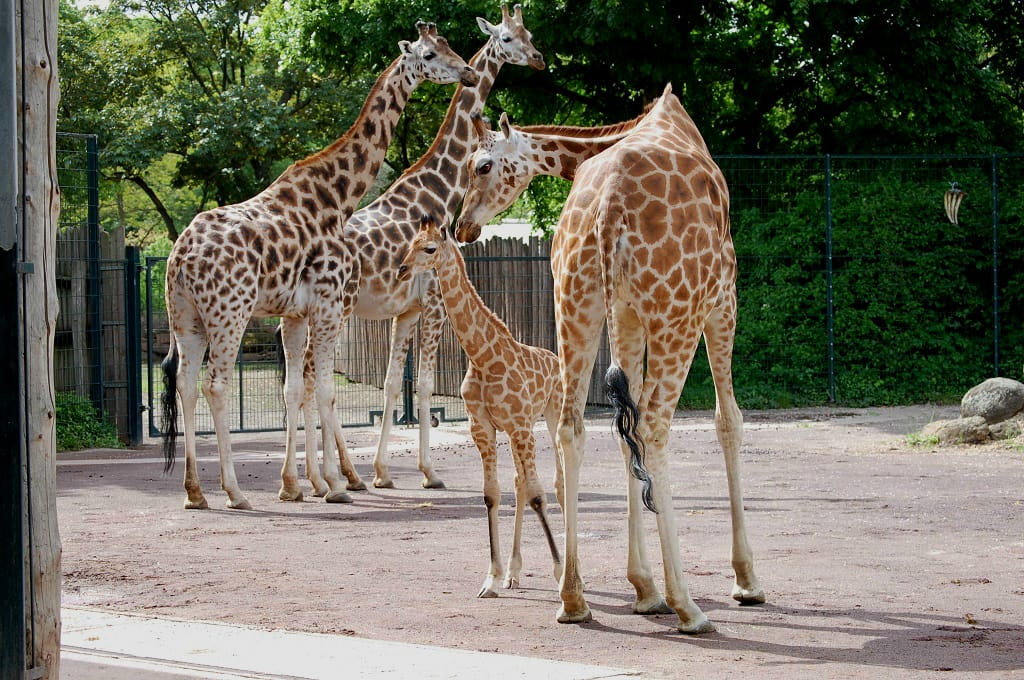
- After a gestation period of about 400 to 460 days (a rather long time!), a young animal measuring 1.70 meters to 1.90 meters is born.
- The young animal is nursed for about a year, but starts nibbling on buds and leaves after just a few weeks.
- Giraffes are “fully grown” at about 10 years of age, but female giraffes reach sexual maturity at about 3.5 years and males a year later.
How many vertebrae does a giraffe’s long neck have?
Quite simply – exactly seven cervical vertebrae, like almost all mammals (only manatees and sloths have varying numbers of 6-8 cervical vertebrae). The length of the neck, however, is not due to a greater number of cervical vertebrae, but rather to their length. A middle cervical vertebra measures approximately 35 centimeters.
How long is a giraffe’s tongue, actually?
The giraffe’s muscular, prehensile tongue is approximately 45 centimeters long and bluish-black. Even young giraffes have a bluish-black tongue. With this prehensile tongue, the giraffe grasps acacia leaves like a loop. Giraffes graze almost constantly: nearly 15 hours a day. A giraffe consumes about 100 kg of food daily. When giraffes eat grass or drink, they must spread or bend their long front legs to reach the ground.
Giraffes know the acacia trick
The acacia branches have thorns that entwine their leaves like barbed wire. Acacias fill their leaves with tannin, a highly toxic substance. The giraffes aren’t bothered by this – they slither their long tongues past the thorns to reach the coveted leaves. The poison doesn’t harm the animals, as they use their saliva as a countermeasure to neutralize the toxin in their mouths. This produces long strands of saliva. But the acacia doesn’t give up. As soon as the giraffe begins to eat the leaves, the ants living on the acacia rush to attack. The ants land on the giraffe’s head and neck and try to bite it. If the ants manage to reach the sensitive inner lining of the nostrils or the gums, it becomes too unpleasant for the giraffe, and it turns away to walk off.